

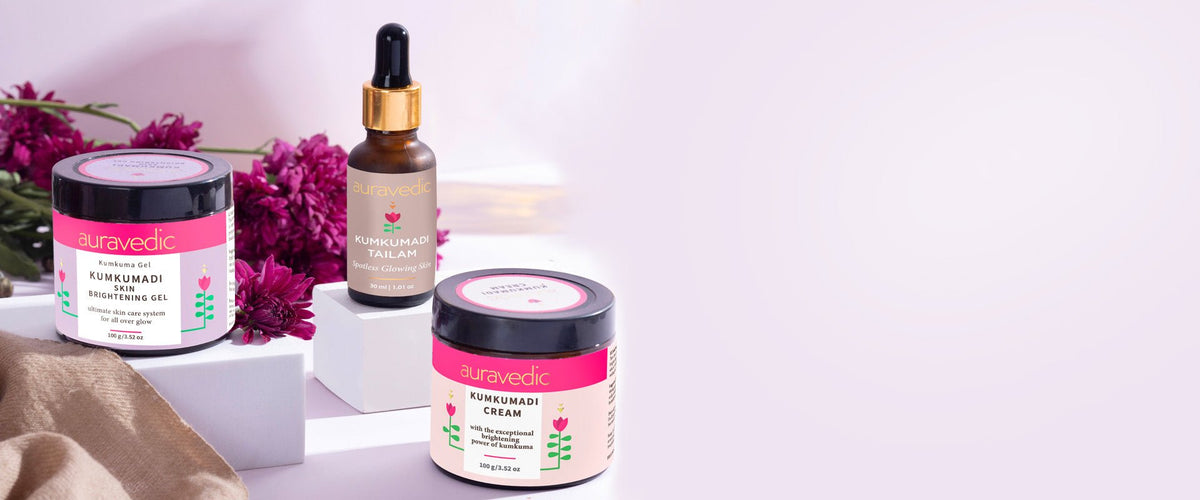
Classical kumkumadi tailam is saffron plus a long list of supporting herbs in a sesame oil base. Ours lists 27 of them. Most are there for a specific reason, and two of them are the reason the oil is not vegan, which almost nobody mentions on the packaging.
Read next: Kumkumadi Tailam: The Complete Guide to India's Saffron Face Oil
What is kumkumadi oil made of?
A sesame oil base, saffron as the lead ingredient, and a set of herbs that fall into rough groups: the ones that even out skin tone, the ones that calm inflammation, and the ones that help the rest absorb.
The classical texts list around 21 ingredients. Formulations vary quite a bit. Ours lists 27, including goat milk, which is unusual in modern versions.
Which ingredient does what?
Kesar, or saffron (Crocus sativus)
The one the formulation is named after. Kumkuma is Sanskrit for saffron and kumkumadi means roughly "saffron and the rest".
It is in there for complexion. Saffron increases blood flow at the surface of the skin, which is why skin looks brighter within a couple of weeks, well before anything happens to actual pigmentation. It carries antioxidants and has mild antibacterial properties too.
Saffron is also why the oil costs what it does. It takes roughly 150 flowers to produce a single gram.
Lal chandan, or red sandalwood (Pterocarpus santalinus)
Second by importance in most formulations. It is a gentle astringent, which is why it appears in products aimed at open pores and uneven texture.
Cooling in Ayurvedic terms. In practical terms it is doing most of the work on pimple marks, blemishes and tan.
Manjistha (Rubia cordifolia)
Classified as a varnya herb, which is the group Ayurveda uses specifically for complexion. It is also a blood purifier in the classical framework, which is why it turns up in formulations meant for skin that breaks out rather than skin that is just dull.
If you are comparing two kumkumadi oils, manjistha is a good thing to look for. It costs more than the fillers that usually replace it.
Daruhaldi, or Indian barberry (Berberis aristata)
Anti-inflammatory and antiseptic. This is what makes the formulation usable on skin that is actively irritated rather than just discoloured. It is similar to turmeric in effect, unrelated botanically, and it does not stain.
Ushira, or vetiver (Vetiveria zizanioides)
The pore ingredient. Also cooling, mildly antiseptic, and responsible for most of the smell. Earthy, slightly grassy, not floral at all.
People who expect kumkumadi oil to smell of saffron are usually smelling vetiver.
Padmaka (Prunus cerasoides)
Commonly translated as lotus, which is wrong. Padmaka is wild Himalayan cherry bark. The confusion is old and it is everywhere, including on packaging.
It reduces inflammation and supports healing, so it matters more for post-acne marks than for sun pigmentation.
Laksha, or lac (Laccifer lacca)
A resin produced by insects on host trees. It speeds up wound healing. It is also one of two reasons this oil is not vegan.
Yashtimadhu, or licorice (Glycyrrhiza glabra)
One of the better-studied ingredients here for pigmentation. Licorice root works on melanin production directly, which makes it one of the few things in this list with a mechanism modern dermatology also recognises.
Neel kamal, or blue waterlily (Nymphaea nouchali)
Cooling and soothing. It is in the formulation for sensitive and inflamed skin rather than for brightening.
Til oil, the base
Not a minor detail. Sesame oil is the traditional carrier for Ayurvedic tailams because it penetrates well and carries fat-soluble compounds into the skin.
It is also why anyone with a sesame allergy should avoid kumkumadi tailam entirely, whatever the brand.
Goat milk
In our formulation and in some classical preparations. It contributes lactic acid, which exfoliates very mildly. Second reason the oil is not vegan.
The full list
Kesar, lal chandan, lac, manjistha, daruhaldi, ushira, padmaka, neel kamal, vat vriksha, ficus lacor, pakar, kamal kesar, bael, agnimantha, shyonaka, gambhari, patala, shalaparni, prishanaparni, gokshura, brihati, kantakari, yashtimadhu, mahua, pattanga, sesame oil, goat milk.
Twenty-seven. The classical formulation runs to about 21, so this one is on the fuller side.
Why do kumkumadi oils vary so much between brands?
Because the name is not protected. Anything can be sold as kumkumadi tailam, and a lot of what is on the shelf is a base oil with saffron colour and fragrance in it.
The ingredient list is where that shows. A formulation naming four herbs is a different product from one naming twenty-seven, whatever the front of the bottle says.
Price follows the same logic. Saffron, manjistha and lal chandan are the expensive parts. A cheap kumkumadi oil has usually economised on exactly those.
What should you look for on a label?
- Saffron named as an ingredient, not as fragrance or colour
- Manjistha, lal chandan and yashtimadhu, which do most of the work on tone
- A sesame or til oil base
- A complete list rather than a summary
- Lac and goat milk disclosed, if you are vegan
Is anything here a problem for sensitive skin?
For most people, no. The formulation is built on cooling anti-inflammatory herbs and several of them are there for irritated skin specifically.
Sesame allergy rules it out completely. If your skin reacts easily, patch test on the inner forearm for 48 hours. And if you are pregnant or breastfeeding, ask a doctor before adding anything new, however natural the list looks.
Where can you see the full list?
All 27 are published on the Auravedic Kumkumadi Tailam product page. Made in Kerala with Kashmiri saffron.
Compare it against whatever else you are considering. If the other brand will not publish a full list, that tells you something on its own.

Leave a comment
This site is protected by hCaptcha and the hCaptcha Privacy Policy and Terms of Service apply.